

 Sebastian James
Key takeaways
- Most messages don't fail because they're bad. They fail because they start in the wrong place, with people who aren't ready to listen.
- Your list isn't one audience. It's people who are Movable Now, Movable Later and Not Movable, and one message can't do every job at once.
- Marketing is for people ready to move now. Persuasion is for people who need an on-ramp first: recognize the problem, explain it, then show the next step.
- A persuasion alignment is a sequencing check that shows where your messages break and what to fix first. It costs $500.
If you work in nonprofit, advocacy or campaign comms, this is familiar. You worked hard on a campaign. The idea is good. The creative is solid. You hit send and...
Nothing. Not backlash. Not debate. Just silence.
The hidden problem
Most messages don't fail because they're "bad." They fail because they start in the wrong place, with the wrong people. They open with urgency, values or an ask before people feel connected or oriented. And they go to people who aren't ready to listen.
In the wild, it looks like three patterns:
- Emergency before connection: "This is urgent" before "Here's what this has to do with your life."
- Values before cause: "We must defend X" before "Here's who is doing what and why."
- Ask before meaning: "Chip in" before "Now I understand what's happening."
Why it keeps happening
You write one message and send it to your whole list. But your list isn't one audience. It's people at completely different starting points. Some are ready to act. Some need context first. Some won't move no matter what you say. One message can't do every job at once, and that's where the mismatch starts.
You need a way to figure out who's ready now and who's ready later.
Enter the persuasion terrain
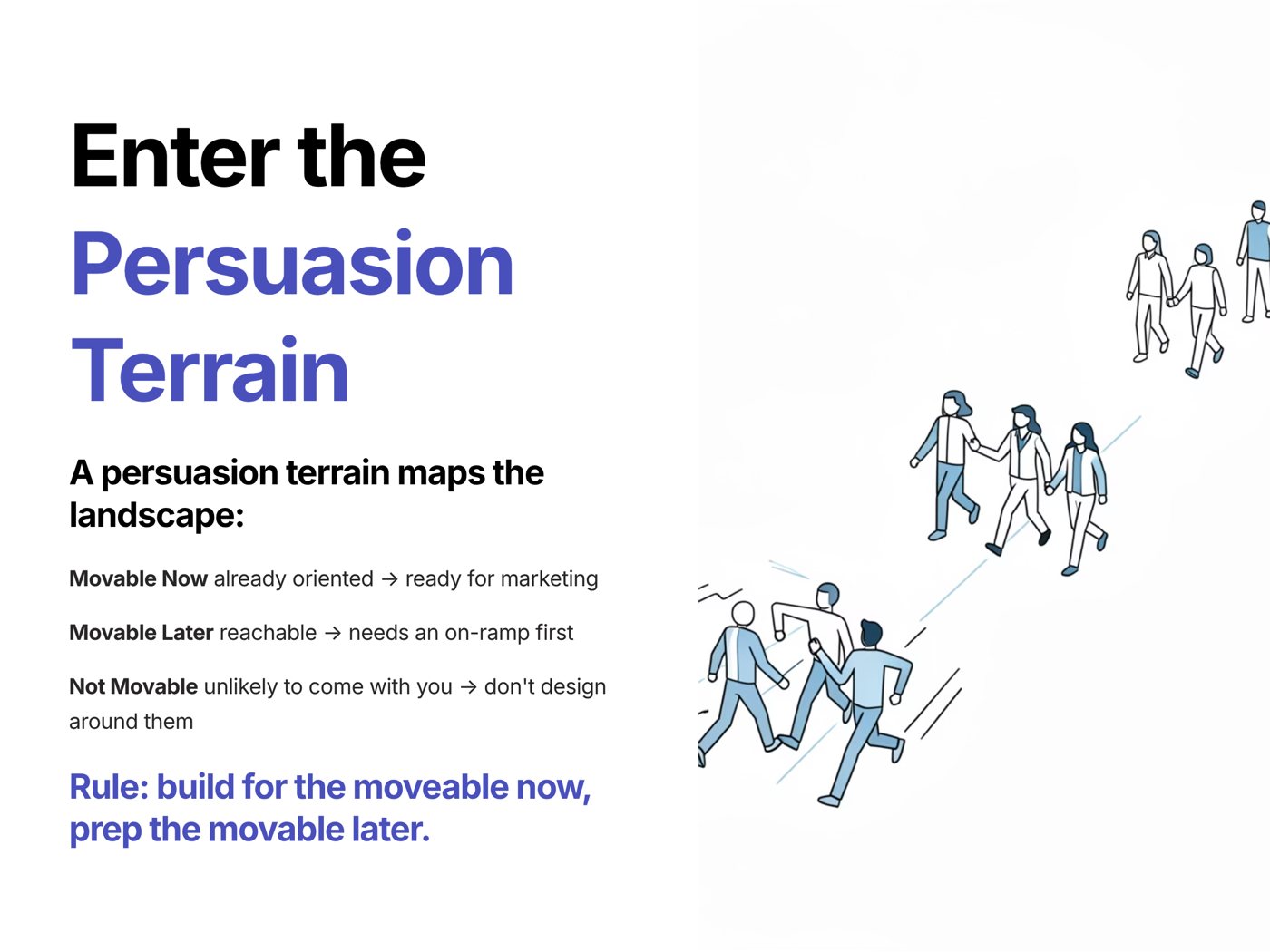
- Movable Now: already oriented and ready for marketing.
- Movable Later: reachable, but they need an on-ramp first.
- Not Movable: unlikely to come with you. Don't design around them.
The rule: build for the Movable Now, and prep the Movable Later. The terrain shows you where people are. A persuasion alignment confirms whether your current messages find them.
The key mismatch

A Move Now message sent to a Move Later audience sounds preachy, panicky, premature and irrelevant. A Move Later message sent to a Move Now audience sounds slow, obvious, hand-holding and condescending. One message can't serve both. That's why you pick an audience first.
That also settles the old marketing-versus-persuasion argument. Marketing is for people ready to move now. It assumes they already get it. Persuasion is for people who will move later. It helps them get oriented and stay that way. No amount of ads will make someone need an exterminator if there are no bugs. Marketing can't change the terrain. Persuasion moves people on it.
What Move Later messages sound like
They recognize real-life situations, help people understand what's going on, name who's doing what without embellishment and offer a small, low-friction next step. They answer three questions in order: "Does this connect to my life?" "Okay, why is this happening?" "What's one small thing I can do?"
Same campaign, side by side:
- Movable Now, marketing style: "This is urgent. Chip in now."
- Movable Later, persuasion style: "If life feels harder than it should, you're not imagining it. Here's what's driving it, and one small step we can take."
Build the on-ramp
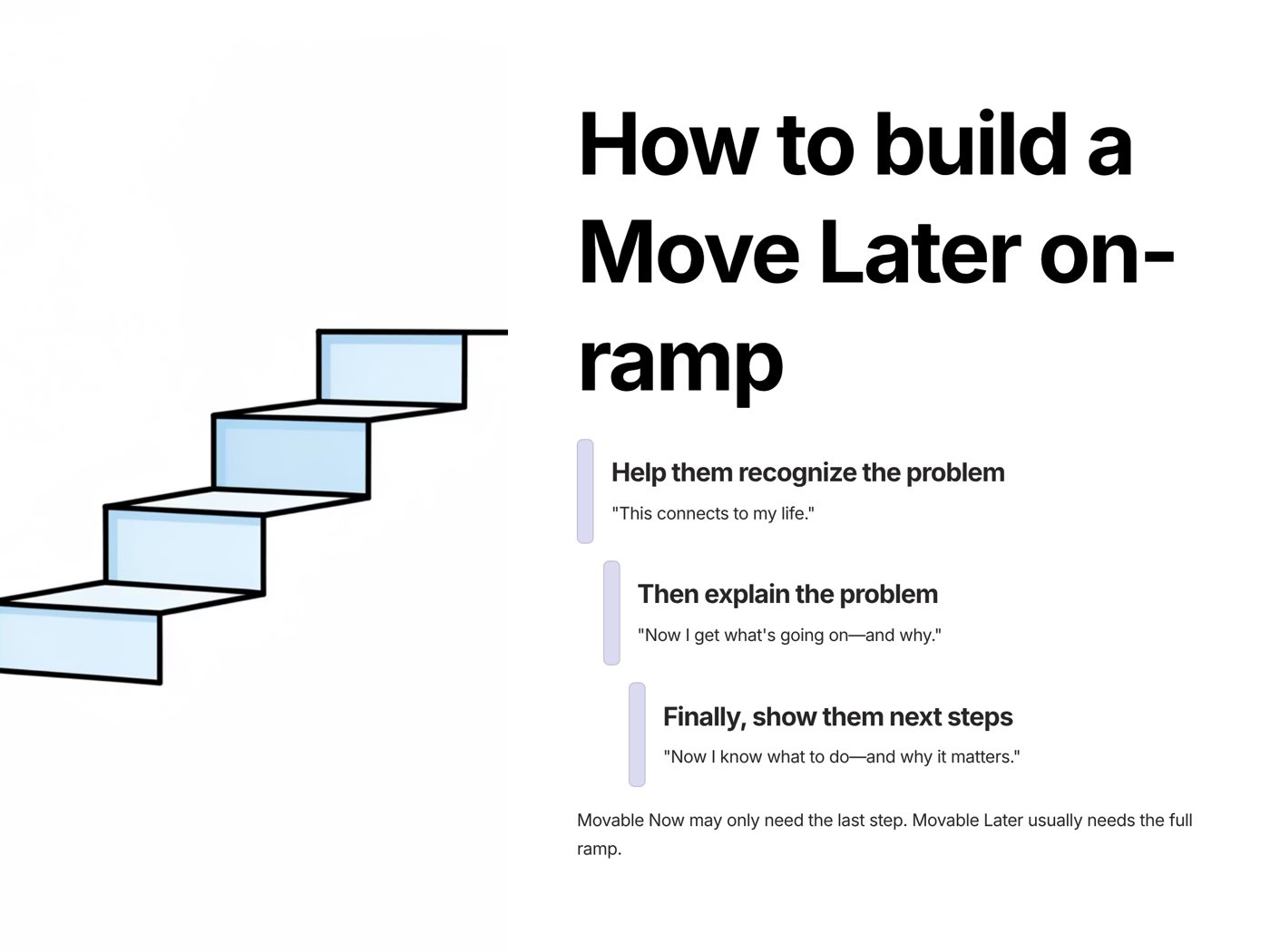
- Help them recognize the problem: "This connects to my life."
- Then explain it: "Now I get what's going on, and why."
- Then show the next step: "Now I know what to do, and why it matters."
What a persuasion alignment does
A persuasion alignment is a sequencing check. It verifies that each message matches its target group, starts at the right step and makes an ask that fits the audience's readiness. It shows you where the sequence breaks, where drop-off is most likely and why, what needs to move earlier or later, and a fix-first list of the highest-leverage changes.
It reliably catches urgency before connection, values before cause, ask before meaning and abstraction without actors, "the system" with no who, what or how. Then it points to the smallest shifts that restore the sequence.
It's not a rewrite marathon. It's a clarity tool that prevents wasted sends. When the sequence holds, more people keep reading, defensiveness drops, understanding gets clearer, asks feel earned and follow-through goes up. All because fewer people drop early.
What about the Not Movable?
Not Movable doesn't mean never respond. It means don't build the whole message around winning them. Talk to them occasionally, then return your focus to the people you can move.
Why I care about this
I've worked in marketing and communications in the private, public and nonprofit sectors. I've screamed at the sky about performance. Had I understood persuasion and message alignment then...
Get your Persuasion Alignment for $500.
We start with the media and messages that change understanding, not what fills the feed. I'll map your terrain (Movable Now, Movable Later, Not Movable), show you if and where the sequence breaks, and give you three fixes. Take the report and get to work, or bring me in to fix it. Hourly and package rates available.
Email me about an alignmentThe Persuasion Alignment
How to read it: If you only have a minute, read the mismatch slide and the on-ramp slide. They're the whole idea in two pictures.
Loading the presentation. If it doesn't appear, open it in Gamma.