

 Sebastian James
Key takeaways
- Shape beats opinion. How an account behaves tells you where to look before a claim tells you what to believe.
- A candidate talking looks sparse and varied: 6 posts in 30 days, all different, with no hashtag stuffing and 0 of 9 automation hints.
- News robots and headline machines are mechanical but ordinary: hashtag-stuffed feeds and repeated headlines are background noise, not rumors in motion.
- A pattern is a place to look, not a conclusion. Shared hashtags are not coordination, and no automation hints is not proof of anything.
With Election Day about two weeks away, election rumors are moving fast online. Most are harmless. Some change whether a person registers, votes or trusts the count.
To tell the difference, don’t start with what an election post claims. Start with its shape: how the account behind it behaves. You can sort a voter from a feed without reading a word, and that tells you where to look before the claim tells you what to believe.
This two-part election field guide comes from FC26, an election-information tracker. FC26 watches public election posts on Bluesky, the Fediverse, Gab, Gettr, Truth Social, Telegram, 4chan and Disqus. It does not judge beliefs. It counts behavior: how often an account posts about the election, when, with how many hashtags, and who it connects to. It also checks each account against nine automation hints.
Everything below comes from four FC26 reports generated Oct. 18, 2026, covering 30 days of public posts about Michigan’s U.S. Senate race and the midterms. Nothing here implies wrongdoing by any account.
Part 1 covers three shapes you will see in any election feed: a candidate talking, a news robot and a headline machine. Learn these, and the odd thing stands out. Part 2 follows a single link claiming voter-registration fraud as it traveled across five platforms.
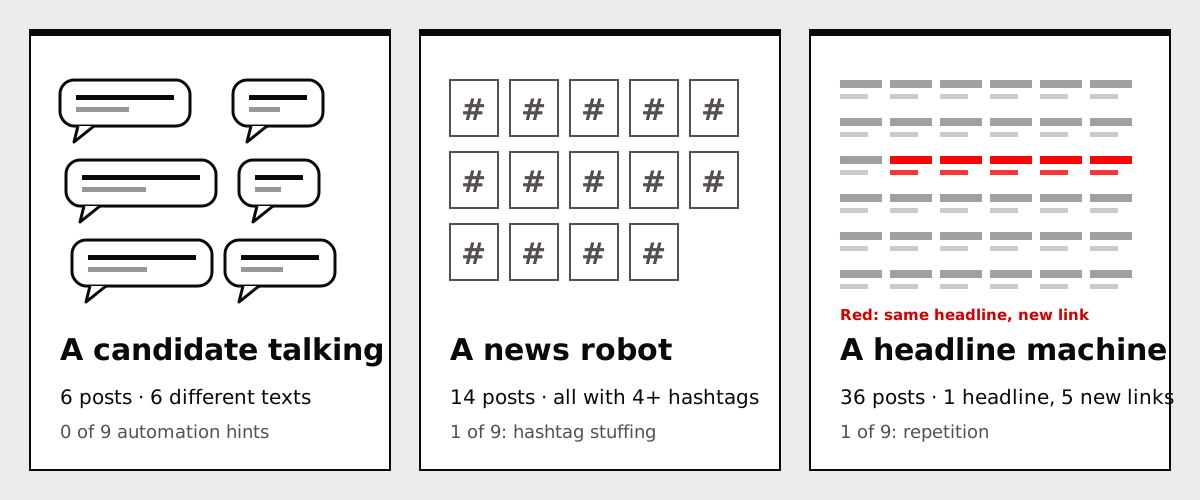
Shape 1: A candidate talking to voters
The account: @abdulelsayed.bsky.social, the Bluesky account of Michigan U.S. Senate candidate Abdul El-Sayed.
- Activity: 6 posts in 30 days, and all 6 used different words.
- Timing: posts landed in 5 different hours of the day.
- Hashtags: no post carried 4 or more.
- Connections: 55 other accounts. He shared 22 mentions with one account; the next highest was 7.
- Automation hints: 0 of 9.
The shape: steady, sparse and human. The timing varies, nothing repeats, and the connections come from talking to people, not tagging election topics.
This is what a person in an election conversation looks like. It is ordinary, and that is the point. You learn the ordinary shape so the odd one stands out.
Shape 2: A news robot
The account: @toppnews.bsky.social, a news aggregator feed.
- Activity: 14 posts, and every one carried 4 or more hashtags, usually #election #michigan #midterm #senate.
- Content: no sentences. Each post is tags plus a link to the same news site.
- Timing: active in 8 of 24 hours.
- Connections: 31, all through shared hashtags.
- Automation hints: 1 of 9, for hashtag stuffing.
The shape: steady and mechanical. It is built to show up whenever someone searches for the Michigan Senate race or the midterms, not to talk with anyone. A feed that tags every election story so it appears everywhere.
Shape 3: A headline machine
The account: @europesays, a Fediverse news-republishing account.
- Activity: 36 posts, 32 of them with 4 or more hashtags. Each is a headline plus a link to its own site.
- Repetition: the same headline appeared with a different link 5 times in 7 hours on Oct. 13 and 14.
- Timing: active in 17 of 24 hours.
- Connections: 85, through shared hashtags.
- Automation hints: 1 of 9, for repetition.
The shape: steady, with bursts. That pattern is consistent with one account republishing an election wire story as it updates across sources. Repetition alone is not coordination.
Side by side
| Trait | Candidate talking | News robot | Headline machine |
|---|---|---|---|
| What it is | Human communication | Hashtag feed | Headline + link repeater |
| Volume | 6 posts | 14 posts | 36 posts |
| Posts with 4+ hashtags | 0 of 6 | 14 of 14 | 32 of 36 |
| Uses own words | All 6 | None | Headline + link |
| Active hours | 5 of 24 | 8 of 24 | 17 of 24 |
| Connections | 55 (mentions) | 31 (hashtags) | 85 (hashtags) |
| Automation hints | 0 of 9 | 1 of 9 | 1 of 9 |
Source: 4 FC26 reports generated Oct. 18, 2026, 30-day window.
What to take from it
Shape beats opinion. Six different texts spread across the day: a candidate talking. Fourteen hashtag storms with no sentences: a robot. The same election headline coming back with new links: a machine. You can tell them apart before you weigh a single claim about the election.
A pattern is a place to look, not a conclusion. Two accounts sharing election hashtags are not necessarily working together. A feed with one automation hint is not doing anything wrong. And FC26’s relevance filter means many posts never get an automation check at all, so the absence of hints is not proof of anything.
None of these three is an election rumor in motion. Candidates talking, feeds tagging and machines republishing are the background of election season online. Knowing that background is what lets you spot a spike.
In Part 2, we follow one that is: a link claiming that most new voter registrations are fraudulent, which jumped to 60 accounts on five platforms in two days. And we ask the question that matters most when you see one: what would settle this?
What shape is the conversation about your race?
Digital Strategy Group runs election narrative scans for candidates, campaigns and organizations. We show you what is moving, how far and what to do about it. Or call or text 773-879-3538.
Email me about a narrative scan